

Methamphetamine withdrawal does not work the way most people expect. There is no seizure risk, no life-threatening blood pressure spike, and none of the acute medical danger that comes with alcohol or benzodiazepine withdrawal. What it does instead is take the brain’s reward system apart piece by piece and then leave the person waiting weeks or months while that system slowly rebuilds. The crash is not the hard part. The weeks after the crash are.
Understanding meth withdrawal symptoms before they arrive matters for two reasons. It tells the person going through withdrawal what is happening and why, which reduces the panic that makes early relapse more likely. And it explains why the withdrawal period requires more clinical support than most people assume after reading a symptom list. The same principle applies to drug abuse and physical dependence more broadly, and the gap between what people expect and what the body actually does is where most unassisted attempts fail.
Key Takeaways
- Meth withdrawal usually starts within the first 24 hours, with the crash bringing heavy fatigue, low mood, increased appetite, and long periods of sleep.
- The hardest part often comes after the initial crash, when depression, cravings, anxiety, poor concentration, and loss of pleasure become more noticeable.
- Acute symptoms often ease within two to three weeks, but cravings, mood changes, sleep problems, and cognitive issues can continue for weeks or months.
- The severity of withdrawal depends on factors such as how long and how often meth was used, dose, method of use, and any existing mental health conditions.
- There is no FDA-approved medication specifically for meth withdrawal, so treatment focuses on managing symptoms, psychiatric support, and behavioral care based on the person’s needs.
- Clinical support does not make the brain recover faster, but it provides a stable environment, symptom monitoring, and ongoing treatment during the period when cravings and depression can be hardest to manage.
How Meth Withdrawal Affects the Brain
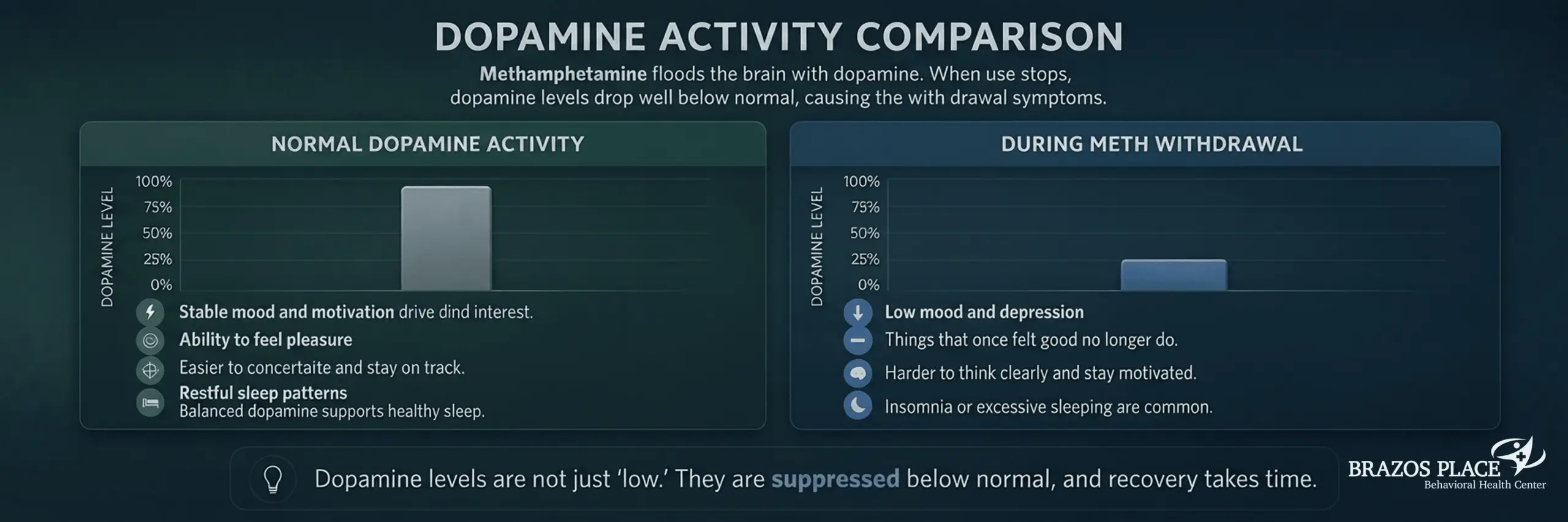
Methamphetamine floods the brain with dopamine at levels far beyond what any natural reward produces. Over time, the brain compensates by reducing its own dopamine production and downregulating the dopamine receptors that respond to it. This is how physical dependence forms. The brain restructures itself around the presence of the drug and adjusts every system it can to stay balanced.
When meth stops, those compensatory changes are still in place. The brain has reduced dopamine output and fewer functional receptors, but now there is no meth providing the flood that was covering the deficit. The most dangerous feature of meth withdrawal is not physical danger but profound depression and anhedonia driven by striatal dopamine depletion, which peaks in the crash phase and can persist for months, significantly elevating suicide risk.
That is the clinical reality most symptom lists describe without explaining. The flatness, the inability to feel pleasure, the motivational collapse these are not psychological weaknesses. They are the neurological consequence of dopamine system depletion, and they resolve on a biological timeline, not an emotional one. How long that takes depends on the person. But understanding that the timeline is biological, not a character test, changes how people approach it.
Meth Withdrawal Timeline by Stage
The Initial Crash (Hours 1 To 48)
Acute withdrawal symptoms such as dysphoria, anxiety, and agitation typically begin shortly after someone’s last use, often within the first 24 hours. The crash is the body’s immediate response to the absence of the stimulant that was keeping it running. Everything that meth was artificially sustaining collapses at once, including energy, mood, appetite suppression, and the artificially elevated sense of capability and focus the drug was producing.
The dominant experience during the crash is exhaustion that goes far beyond normal tiredness. People sleep for extended stretches, sometimes 18 to 20 hours at a time, because the central nervous system is in a state of rebound suppression after sustained overstimulation. Appetite returns sharply after days or weeks of meth-induced suppression. The mood in this phase is low but relatively stable, because the brain is too depleted to generate much emotional activity in either direction.
The crash is uncomfortable, but it is the most manageable phase of meth withdrawal for most people. The problem is that it passes and is followed by something harder.
The Acute Withdrawal Phase (Days 3 To 10)
Acute stimulant withdrawal typically lasts 7 to 10 days, though it is common for certain psychological symptoms to last several weeks. This is the phase where the real difficulty of methamphetamine withdrawal becomes clear. The extreme fatigue of the crash begins to lift, but what replaces it is not normalcy. It is a combination of symptoms that compete with each other and make daily function difficult.
Physical symptoms during this phase include:
- Disrupted sleep that swings between insomnia and hypersomnia, often within the same week.
- Vivid, unpleasant dreams during sleep periods.
- Continued increased appetite alongside nausea.
- Headaches and general physical discomfort.
- Muscle weakness and tremors in some cases.
The psychological symptoms are what make this phase genuinely dangerous:
- Depression that can reach clinical severity and, in some cases, suicidal ideation.
- Anhedonia, which is the clinical term for the inability to feel pleasure from anything. This is one of the most consistent and distressing features of meth withdrawal. Activities that previously brought satisfaction feel completely flat.
- Intense, persistent drug cravings that spike when the person encounters anything associated with past use: people, places, routines, even specific times of day.
- Anxiety and agitation that make rest difficult even when the person is exhausted.
- Cognitive fog, including difficulty concentrating and short-term memory disruption.
- In some cases, particularly among people who used heavily for extended periods, paranoia and psychotic symptoms, including hallucinations.
The craving and depression combination during this window is the primary driver of early relapse. The person feels physically better than they did during the crash, which creates a false sense that they are past the hardest part, while the psychological symptoms are actually at or near their peak. This is the clinical reason why supportive care is so important during meth withdrawal, and it is also why the importance of detox programs in addiction recovery is not just about managing physical symptoms. The psychological monitoring during this window is the more critical function.
The Subacute Recovery Phase (Days 10 To 21)
Most of the acute physical symptoms begin easing after day 10, but the psychological picture often does not follow the same curve. Cravings remain elevated. Depression persists at varying intensity. Sleep continues to be disrupted. The withdrawal timeline typically begins within 24 hours of the last dose, peaks between days 3 and 7, and generally subsides within two to three weeks, though some individuals experience prolonged symptoms known as PAWS.
This phase is where the person begins to look and act more functional from the outside while still experiencing significant internal distress. That gap between appearance and reality makes this a high-risk period for people managing withdrawal without clinical support. The people around them often assume recovery is going well based on surface observation, while the internal experience is still far from stable.
When Withdrawal Symptoms Last for Months
Post-acute withdrawal syndrome following methamphetamine use disorder produces intermittent depression, cognitive impairment, and intense cravings for months after acute symptoms resolve. PAWS is not a separate condition. It is the continuation of the brain’s recovery from dopamine system disruption on a timeline that extends well beyond the acute withdrawal window. Understanding psychological dependence and how it persists after physical withdrawal ends helps explain why PAWS catches so many people off guard.
The pattern of PAWS is intermittent rather than constant. Weeks can pass with relatively stable mood and function, followed by a period of intense craving, flat affect, or depressive symptoms that arrives without an obvious trigger. These waves are neurologically driven, not situational. They reflect the brain’s ongoing recalibration rather than a relapse in recovery progress. PAWS is one of the clinical arguments for residential treatment that extends beyond the acute withdrawal period. A person who completes 30 days of residential care and transitions into a structured sober living program is in a substantially better position to manage PAWS episodes than someone who is discharged after detox and returns to their previous environment alone.
What Makes Meth Withdrawal More Severe
Not everyone experiences the same intensity or duration. Several factors shift where a person lands on the spectrum.
- Duration and frequency of use. Daily use over years produces more pronounced dopamine system disruption than intermittent use over months.
- Method of administration. Smoking and injecting meth deliver higher doses more rapidly than oral use and produce more severe dependence and withdrawal.
- Purity and dose. Higher-purity meth at higher doses accelerates the neurological changes that drive withdrawal severity.
- Co-occurring mental health conditions. Depression, anxiety, and PTSD are all common alongside methamphetamine use disorder. These conditions intensify withdrawal symptoms and make the psychological phase considerably harder to manage.
- Previous withdrawal history. Prior withdrawals do not produce the same kindling effect as alcohol, but the psychological patterns built around past use create conditioned responses that complicate the current withdrawal.

How Meth Withdrawal Symptoms Are Treated
Unlike opioid withdrawal, which has Suboxone and methadone, or alcohol withdrawal, which has benzodiazepines, there are no FDA-approved medications specifically for methamphetamine withdrawal. This is a commonly misunderstood point. It does not mean medication is irrelevant. It means there is no single approved protocol, and clinical management is supportive and individualized. This distinction matters when comparing drug rehab services across different substance types, because what a meth withdrawal program looks like clinically is quite different from opioid or alcohol detox.
In practice, the clinical team managing meth withdrawal at a supervised facility can address specific symptoms: sleep aids for the insomnia phase, medications to manage acute anxiety, antidepressants for severe depression, and in cases with psychotic symptoms, appropriate psychiatric medication. The Matrix Model, a structured behavioral treatment specifically developed for stimulant use disorders, is the evidence-based therapeutic approach used alongside supportive medical care.
Why the Psychological Symptoms Are Often Harder
Most people planning to stop using meth focus their fear on the physical symptoms. The crash sounds terrible on paper. But most people who have been through meth withdrawal report that the crash was the part they could endure. The anhedonia is harder. Weeks of not being able to feel pleasure from anything, combined with intense craving for the one thing that used to produce it, in an environment full of cues associated with past use that is what breaks most attempts to quit without support.
The clinical term for this vulnerability is cue-induced craving, and it is a neurological response, not a failure of willpower. When the brain has learned to associate specific environmental cues with dopamine flooding, it produces a craving response to those cues automatically. Distance from those cues is one of the most effective tools available during this period. Residential treatment provides that distance in a way that outpatient settings cannot during the early weeks of methamphetamine withdrawal.
How Clinical Support Helps During Withdrawal
Supervised withdrawal management does not shorten the biological timeline of meth withdrawal. The dopamine system rebuilds on its own schedule regardless of where a person is doing it. What supervised care provides is a stable, substance-free environment with clinical monitoring, psychiatric assessment, management of the most acute symptoms, and a direct transition into the residential treatment program that addresses the underlying addiction rather than just the withdrawal.
At Brazos Place, the inpatient detox and residential treatment program handles both phases without a gap between them. The withdrawal period and the therapeutic work that follows happen at the same facility with the same clinical team, so the person does not have to navigate a transition back into a non-clinical environment at the most psychologically vulnerable point in the process. The dual diagnosis support available inside the residential program matters particularly for meth withdrawal, because the depression and anhedonia of the withdrawal period frequently unmask underlying mental health conditions that were being self-medicated before treatment began.